
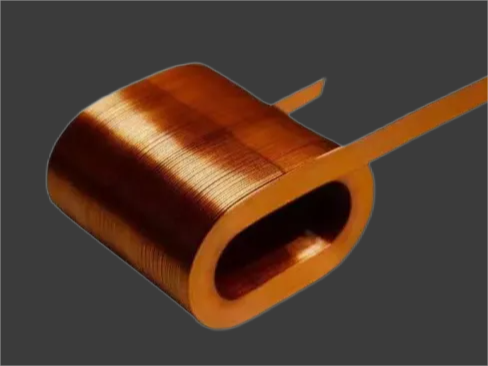
Designing a flat wire coil requires careful consideration of dimensions, winding techniques, and the use of winding fillets to ensure proper performance. Here’s a guideline to help you design a flat wire coil with appropriate dimensions and winding fillets:
-
- Define the requirements:
-
- Determine the application and purpose of the coil.
-
- Specify the required dimensions of the coil, including length, width, and height (thickness) of the flat wire.
-
- Define the requirements:
-
- Select flat wire dimensions:
-
- Choose the appropriate dimensions of the flat wire based on the current carrying capacity, space constraints, and mechanical strength requirements.
-
- Consider standard flat wire sizes available in the market or customize the dimensions if necessary.
-
- Select flat wire dimensions:
-
- Calculate the number of turns:
-
- Determine the required inductance (L) for your application.
- Use the formula for inductance of a flat coil, which is similar to that of a rectangular coil but modified to account for the flat wire’s cross-sectional area.
- Rearrange the formula to solve for the number of turns.
-
- Calculate the number of turns:
-
- Design winding fillets:
-
- Winding fillets are small curved sections at the edges of the coil that help prevent sharp bends in the wire, reduce stress concentrations, and improve electrical performance.
-
- The radius of the winding fillets should be smaller than the width of the flat wire to ensure smooth winding without causing damage to the wire.
-
- Typically, the radius of the winding fillets can be around 50% to 80% of the width of the flat wire, depending on the wire’s flexibility and mechanical properties.
-
- Use specialized winding tools or winding machines with appropriate guide mechanisms to achieve consistent and uniform winding with proper fillets.
-
- Design winding fillets:
-
- Assemble the coil:
-
- Prepare a suitable form or mandrel with dimensions matching the desired coil dimensions.
-
- Begin winding the flat wire around the form, ensuring that the turns are tightly packed and aligned properly.
-
- Incorporate winding fillets at the edges of the coil by smoothly transitioning from one turn to the next, maintaining the desired radius for the fillets.
-
- Secure the ends of the wire to prevent unwinding and ensure electrical continuity.
-
- Assemble the coil:
-
- Test and optimize:
-
- Test the coil in your application to verify its electrical performance, including inductance, resistance, and frequency response.
-
- Optimize the design if necessary based on performance feedback, such as adjusting the number of turns or refining the winding technique.
-
- Test and optimize: